2023. Scales of Resistance: Transborder Organizing in the Americas. Duke University Press.
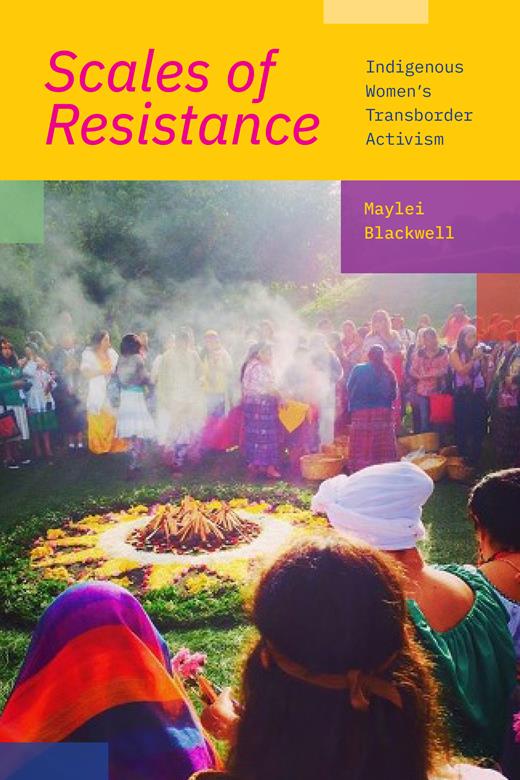
In Scales of Resistance Maylei Blackwell narrates how Indigenous women’s activism in Mexico and its diaspora weaves in and between local, national, continental, and transborder scales. Drawing on more than seventy testimonials and twenty years of fieldwork spent accompanying Indigenous women activists, Blackwell focuses on how these activists navigate the blockages to their participation and transform exclusionary spaces into scales of resistance. Blackwell shows how activists in Mexico and those in the migrant stream that runs from Oaxaca into California redefined women’s roles in community decision-making. They did so by scaling down Indigenous autonomy to their own bodies, homes, and communities; grounding their political claims within Indigenous epistemologies and the gendered nature of social organization; and scaling up to regional, national, and continental contexts. This allowed them to place themselves at the heart of Indigenous resistance and autonomy, decolonizing gender hierarchies and creating new scales of participation. Blackwell reveals the importance of moving across different types of scale and contrasting colonial divisions of scale itself with Indigenous conceptions of scale, space, solidarity, and connection.
Access the book for free by open access
“The importance of Maylei Blackwell’s theoretical intervention and her ethnographic material cannot be overstated. Providing a new understanding of Indigenous migration and transnational organizing, Scales of Resistance will make an invaluable contribution to feminist studies, Native American and Indigenous studies, hemispheric American studies, Latinx studies, and critical ethnic studies.” – María Josefina Saldaña-Portillo, author of Indian Given: Racial Geographies across Mexico and the United States
“Maylei Blackwell’s Scales of Resistance is essential reading for those of us interested in how Indigenous feminisms transform settler colonial histories across geographies, borders, families, and bodies. Her collection of eyewitness accounts, ethnographic interviews, and her analysis of interstitial and multiscalar political activisms in Mexico, from Oaxaca to California, testifies to how Indigenous women have organized throughout the Americas to transform scales of power into resistance.” – Jodi A. Byrd, author of The Transit of Empire: Indigenous Critiques of Colonialism
“This book will stimulate discussion among activist-scholars working with Latin American and Latinx women’s social movements, and I expect Blackwell’s approach and the concepts of geographies of difference, geographies of indigeneity, and scale will be effective for activist-scholars across the globe.” – Patricia Zavella, University of California, Santa Cruz
“In Scales of Resistance, Blackwell rethinks scale beyond solely its colonial and masculinist forms by centering Indigenous women’s organizing and geographies. By highlighting the work that Indigenous women (sometimes migrants) do at varying scales, as well as the creation of new scales based on their readings of power in different places and their own cosmovisions, Blackwell’s book is an important corrective to scalar analyses that invisibilize marginalized actors.” – Rebekah Kartal, Antipode
“Overall, Scales of Resistance is an invaluable contribution to social science and humanities literature. Blackwell’s rigorous analyses and insightful observations provide amuch-needed account of the vital roles of Indigenous women’s agency and activism in the Americas and in what will always be their forever home. Highly recommended. Advanced undergraduates through faculty; professionals.” – T. M. Montoya, Choice
“The strength of the theoretical argument lies in the interaction between the various case studies explored in the chapters, as well as in their interrelation among struggles, allowing for an exploration of the different scales of indigenous women’s organization and considering them as interconnected rather than separated by national or political borders. … While the opening up of the concepts of scale and boundary remains a major theoretical contribution, [Scales of Resistance] also subtly showcases the strength of indigenous women’s movements and their repertoire of rich, diverse, and unique actions, constituting an equally important empirical contribution.”- Andreanne Brunet-Belanger, Journal of Borderlands Studies
“Scales of Resistance is a powerful work that unpacks the intricate dynamics of Indigenous women’s activism across, within, and through a myriad of scales. The book has contributed powerfully to a feminist geographic lens by providing a needed critical perspective on decolonial understandings of space.” – Lucas Belury, Gender, Place & Culture
“Maylei Blackwell’s Scales of Resistance is a monumental intellectual contribution to community-based collaborative research in Indigenous studies and critical race studies. Theoretically complex and complete, as well as full of heart, this book asks to be read in small increments, digested, then revisited, then reflected upon to arrive at a full recognition of its singular impact.” – Gayatri Devi, Resources for Gender and Women’s Studies
“I was nourished by the deep care that this book exudes. The chapters provide extensive interview excerpts and vignettes of Blackwell’s time with other activists, and her grounding and investment in relationships is palpable. Scales of Resistance offers a reading experience that counters the feeling of loneliness that has festered over the past three years. The coda begins with Blackwell’s powerful naming of some of the emotions that coincide with and guide this work. Alongside the joy of these collaborations, she also gives voice to the despair that I suspect most of us have at times felt as we confront and write about these challenges. As an early career scholar, I am grateful to see such a pivotal figure in the field acknowledging how heavy this time has been and continues to be, and I felt revitalized by the experiential, theoretical, and emotional knowledge that Blackwell weaves together.” – Kenna Neitch, Signs
2018. Chicana Movidas: New Narratives of Activism and Feminism in the Movement Era. Dionne Espinoza, María Eugenia Cotera and Maylei Blackwell, ed. Austin: University of Texas, 488 Pp.
With contributions from a wide array of scholars and activists, including leading Chicana feminists from the period, this groundbreaking anthology is the first collection of scholarly essays and testimonios that focuses on Chicana organizing, activism, and leadership in the movement years. The essays in Chicana Movidas: New Narratives of Activisim and Feminism in the Movement Era demonstrate how Chicanas enacted a new kind of politica at the intersection of race, class, gender, and sexuality, and developed innovative concepts, tactics, and methodologies that in turn generated new theories, art forms, organizational spaces, and strategies of alliance.
These are the technologies of resistance documented in Chicana Movidas, a volume that brings together critical biographies of Chicana activists and their bodies of work; essays that focus on understudied organizations, mobilizations, regions, and subjects; examinations of emergent Chicana archives and the politics of collection; and scholarly approaches that challenge the temporal, political, heteronormative, and spatial limits of established Chicano movement narratives. Charting the rise of a field of knowledge that crosses the boundaries of Chicano studies, feminist theory, and queer theory, Chicana Movidas: New Narratives of Activisim and Feminism in the Movement Era offers a transgenerational perspective on the intellectual and political legacies of early Chicana feminism.
**Winner, Best Multiauthor Nonfiction Book, International Latino Book Awards, 2019
“Chicana Movidas challenges us to think more capaciously about the development of Chicana feminism and about movement history more generally. As this stunning collection offers us examples of the small acts that have helped to construct radical versions of feminism, it also provides considerable organizing insights for emerging activists who value anti-racist, anti-imperialist, and queer perspectives.” ~Angela Y. Davis
“A revelatory, energetic mixtape of memory, theory, and movidas. Essential reading in Chicana/o studies.” ~Vicki L. Ruiz,author of From Out of the Shadows: Mexican Women in Twentieth-Century America
“This collection, like the Chicanas who challenged sexism during the Civil Rights Era, is anything but passive. There’s nothing out there like it.” ~Ms. Magazine
“Chicana Movidas makes a strong contribution to movement studies, as well as its feminist intentions…This collections marks how bearing witness to a movement and writing from the individual ‘I’ can be a key movida that inspires others to voice and incites other strategies for social change.” ~La Bloga
“We are witnessing a new racial and social movement, and Chicana Movidas serves as the perfect companion to the new Chicana revolution…Focusing on multiple subjects, from race to gender and sexuality, this anthology serves as a refreshing contribution to social activism and identity equality.” ~Latinx Spaces
“A landmark anthology.” ~New Books Network: Latino Studies
“[A] timely and important book…The twenty-one scholarly essays, testimonies, and interviews included in this collection build on the work of pioneering Chicana feminist scholars, activists, and artists as they both trouble the construction of a homogeneous Chicana feminist subject by Chicano and feminist movement historiography and point to new and important lines of inquiry in Chicana feminist studies.” ~Latino Studies
“Chicana Movidas is the collection to advance the history of Chicanas and the historiography of the Chicano movement into the twenty-first century…masterful.” ~Lina-Maria Murillo, Pacific Historical Review
“Chicana Movidas is a ceremonial discovery of powerful women who, through varied and diverse acts of mobilization, excavated spaces for Chicanas to thrive before, during, and after the Chicano movement era. This collection of first-person accounts, critical investigations, and interviews paints a vivid, detailed, and deeply personal picture of how these Chicana activists fostered spaces to express their complex identities, fight for their unique concerns, and make social change…all Chicanas deserve the ceremony of reading this book, not only to honor themselves and the women who grace the pages, but to heal, rejuvenate, and tap into a powerful collective consciencia.” ~Bonnie Cox, Chiricú Journal
“A riveting collection of essays and testimonios that set out to remember that which has been lost in the fire, the lineage of Chicana feminist visionary insurgencies…Chicana Movidas is vital reading to a vast array of academic disciplines and popular audiences interested in culture and history. It weaves a tapestry of recetas through which to recover and assert retrofitted Chicana memory praxis that tells the stories of Chicana feminisms in constant motion and imagination, provocation and movement.” ~Canadian Journal of Latin American and Caribbean Studies
2011. ¡Chicana Power! Contested Histories of Feminism in the Chicano Movement. University of Texas Press, (Chicana Matters Series). 300 Pp.
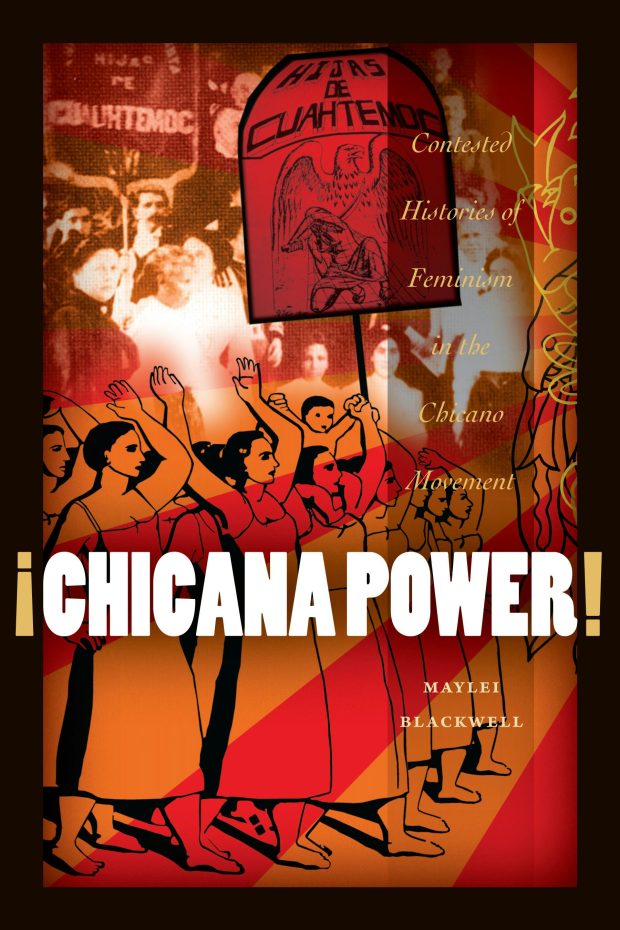
The first book-length study of women’s involvement in the Chicano Movement of the late 1960s and 1970s, ¡Chicana Power! tells the powerful story of the emergence of Chicana feminism within student and community-based organizations throughout southern California and the Southwest. As Chicanos engaged in widespread protest in their struggle for social justice, civil rights, and self-determination, women in el movimiento became increasingly militant about the gap between the rhetoric of equality and the organizational culture that suppressed women’s leadership and subjected women to chauvinism, discrimination, and sexual harassment. Based on rich oral histories and extensive archival research, Maylei Blackwell analyzes the struggles over gender and sexuality within the Chicano Movement and illustrates how those struggles produced new forms of racial consciousness, gender awareness, and political identities.
¡Chicana Power! provides a critical genealogy of pioneering Chicana activist and theorist Anna NietoGomez and the Hijas de Cuauhtémoc, one of the first Latina feminist organizations, who together with other Chicana activists forged an autonomous space for women’s political participation and challenged the gendered confines of Chicano nationalism in the movement and in the formation of the field of Chicana studies. She uncovers the multifaceted vision of liberation that continues to reverberate today as contemporary activists, artists, and intellectuals, both grassroots and academic, struggle for, revise, and rework the political legacy of Chicana feminism.
“Maylei Blackwell’s book is an in-depth study of women’s involvement in the Chicano Movement (el movimiento) of the late 1960s and 1970s. As Chicanos in the US organized and protested in efforts to address social issues faced by the community, women began to actively engage with the many gender gaps within the movement. This ultimately led to new forms of gender consciousness, awareness and political identities that challenged the confines of Chicano nationalism. Blackwell draws on oral history and archival research to illustrate these struggles, and provides examples of pioneering Chicana activists, theorists, and feminist organizations.” ~JSTOR Daily
“Maylei Blackwell’s ¡Chicana Power!, the first book-length study of Chicanas in the Chicano movement, uses oral history and archival research to tell the compelling story of Las Hijas de Cuauhtémoc, a group that emerged in the late 1960s […] One of the book’s many strengths is Blackwell’s decision to foreground the voices of the organization’s former members, allowing their firsthand accounts to communicate how their struggles over gender and sexuality within the movement ultimately gave rise to the “multifaceted vision of liberation” they created, which, as Blackwell argues, resulted in the production of “a new Chicana political identity”” ~Yolanda Padilla, Western American Literature
“An excellent resource for oral historians and students, this book provides new interdisciplinary approaches, revealing to the expert and the novice alike innovative techniques. Likewise, the oral histories place women in the Mexican community as subjects of Chicana feminism and their place in US history.” ~ María A. Beltrán-Vocal, Oral History Review
“Memory is central to this project, and it is articulated through Black well’s use of oral history as a methodology in telling the story of how Chicanas struggled to expand and thereby transform the manuscript of Chicano power. Though many historians regard oral history as suspect given the vagaries of memory, Blackwell contentiously asks us to give memory—with all of its inherent flaws—its due.” ~ Maria E. Cotera, Signs
“¡Chicana Power! is an engaging, provocative and exciting book.”~Yolanda Chávez Leiva, Western Historical Quarterly
“One of the pleasures of this book is the strength of the interviewees’ voices, which come through with emotion, working-class dialects, and polemics intact. Blackwell folds many voices into the book, allowing the women to retell, through their own memories and thoughtful analyses, their experiences in an emerging landscape of women of color feminisms that included Chicana feminism.” ~T Jackie Cuevas, National Political Science Review
“Blackwell va mas allá al afirmar que [la] cultura de la imprenta feminista chicana supuso un impulso esencial para los primeros feminismos de la mujer de color, puesto que estas imprentas se encargaban de crear antologías sobre el desarrollo de la ideología feminista al tiempo que eran una practica política de divulgación de ideas a nivel local y nacional.” ~Ignacio F. Rodeno Iturriaga, Letras Femeninas
“[T]he project chronicles the development of Chicana feminism, not simply in response to Chicano nationalism, but also in relation to other racial discourses in the United States. In doing so, Blackwell constructs a rich and complex historiography that explores oppositional consciousnesses already present within colonial hegemonic and hetero-patriarchal traditions.” ~R Allen Barros, The Arizona Quarterly
 Professor Maylei Blackwell